Compress PDF to 150 KB
Compress your PDF files to 150 KB quickly and easily using pdfFiller’s online tool, perfect for sharing and storage.
What is the Compress Tool?
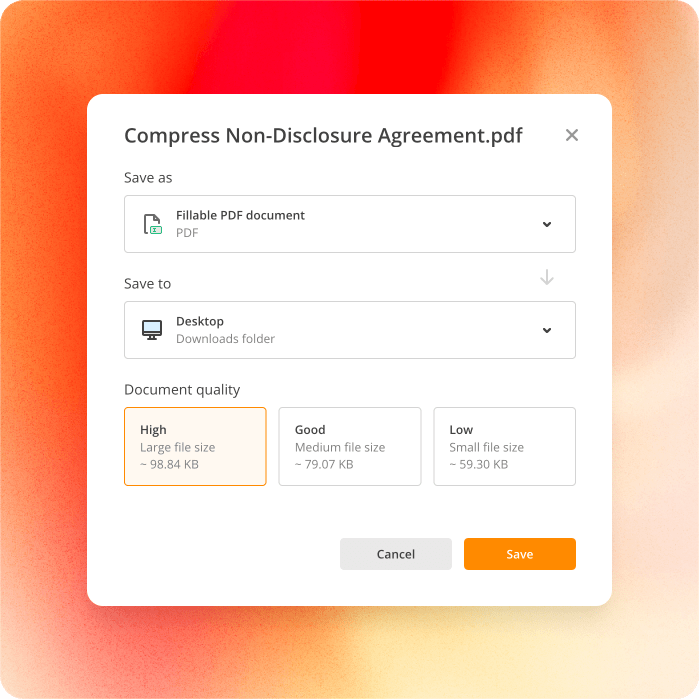
The Compress tool in pdfFiller is designed to reduce the file size of your PDF documents, making them easier to share and store. You can access this tool from the editor header or the All Tools dashboard. It is particularly useful for small and medium-sized businesses that need to manage document workflows efficiently. By using the Compress tool, you can optimize your PDFs without sacrificing quality, ensuring that your documents remain professional and easy to handle.
Why Compress Your PDF Files?
Reducing PDF file sizes is essential for effective document sharing. Large files can lead to slow upload times and may exceed email attachment limits. By compressing your PDFs, you can improve the speed of your document workflows and enhance collaboration with clients and colleagues. For instance, a freelancer sending a project proposal can ensure it reaches the recipient without issues caused by size limitations. Additionally, smaller files save storage space, making them easier to manage.
How to Access the Compress Tool
You can easily find the Compress tool within pdfFiller. Look for the Compress button in the editor header when you have a document open. Alternatively, you can access it through the All Tools dashboard without needing to open a specific document. This straightforward navigation ensures that you can quickly get to the tool whenever you need to compress a PDF.
Uploading Your PDF for Compression
To compress a PDF, you first need to upload your document into pdfFiller. The platform supports various formats, including PDF, DOCX, and images. When you upload a document, pdfFiller automatically converts it to a compatible format for compression. This process ensures that you can work with your files without worrying about format issues.
Steps to Compress a PDF
- Open your PDF document in pdfFiller.
- Locate the Compress button in the editor header.
- Click on the Compress button to initiate the compression process.
- Select your desired compression quality level: High, Medium, or Low.
- Review the compression settings and confirm your choice.
- Wait for the tool to process your document.
- Once completed, you will receive a notification that your PDF is ready.
- Download the compressed PDF to your device.
Choosing Compression Quality Levels
When using the Compress tool, you can choose from three quality settings: High, Medium, and Low. The High setting minimizes visual changes while reducing file size slightly. The Medium setting offers a balanced approach, while the Low setting maximizes size reduction but may impact image quality. Selecting the right quality level depends on your needs — if you prioritize file size over image fidelity, the Low setting may be suitable.
What Changes After Compression?
After compressing a PDF, the content of your document may change, particularly regarding images. While text and form data remain intact, images may experience quality loss depending on the compression level selected. This means you can expect your document's structure and important information to stay preserved while optimizing the overall file size.
Expected File Size Reduction
File size reduction varies based on the content of your PDF. For image-heavy documents, you can expect significant size reductions, while text-only PDFs may see minimal changes. It's important to note that already-optimized files will yield near-zero reduction. Therefore, understanding the type of content in your PDF can help set realistic expectations for compression outcomes.
Downloading Your Compressed PDF
After the compression process is complete, you can easily download your compressed PDF. Simply follow the on-screen instructions to save the file to your device. If the file is still too large for your needs, consider adjusting the compression quality settings and repeating the process to achieve a smaller size.
Compress vs. Other Size-Reduction Methods
The Compress tool differs from other size-reduction methods like Delete Pages, Split, and Save As. While Delete Pages removes unnecessary content, and Split divides the document into smaller parts, the Compress tool focuses solely on reducing file size without altering the document's structure. This makes it an ideal choice for small businesses looking to maintain document integrity while optimizing for size.
Industry Scenarios for PDF Compression
Consider a small business that frequently sends contracts to clients. Compressing these PDFs ensures they can be emailed without exceeding size limits. A freelancer submitting a portfolio can benefit from reduced file sizes, making it easier to share with potential clients. Additionally, professionals managing large reports can compress documents to facilitate quicker sharing and collaboration, enhancing overall workflow efficiency.
How Does pdfFiller Compare?
Smallpdf offers a simple interface for PDF compression but lacks the extensive features of pdfFiller. Users may miss out on additional document management tools. ilovepdf provides basic compression options but does not integrate as seamlessly with other document workflows. Users may need to switch between tools. Adobe Acrobat is a powerful tool with comprehensive features, but it can be complex and costly for small businesses. Users may find it overwhelming for simple tasks.